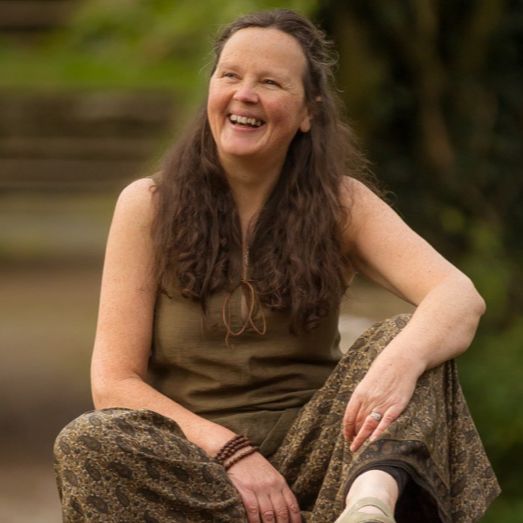
Why the Voice?

Why have I chosen to work so closely with the human voice?
Why does it remain at the heart of my one-to-one work, teaching, retreats and professional training?
The voice is unlike any other instrument. It carries breath, vibration and sound, but it also carries something of who we are—our history, emotion, identity, relationship and presence.
Our voices reveal things we may not consciously intend to express. They can become quieter when we feel uncertain, tighten when we are afraid, brighten with joy or soften when we feel safe.
The voice lives at the meeting place between our inner and outer worlds.
My Own Relationship with Voice
For much of my life, I had a love–hate relationship with my voice.
I always loved to sing and talk, yet I carried a belief that my voice was not good enough to be heard or shared fully. My speaking voice was often accompanied by self-judgement and control.
I would sometimes rehearse what I wanted to say in my head—or quietly form the words in my mouth—before allowing myself to speak aloud. What I felt inwardly seemed to need to be measured, filtered and adapted before it could be safely expressed.
Even when I appeared confident or outspoken, part of me was listening for what other people wanted to hear. I became skilled at adjusting myself to gain acceptance, but the more I did that, the less clearly I knew myself.
My voice became hidden beneath expectation and compromise.
When the Old Ways No Longer Worked
In 2006, following my father’s death and the ending of my marriage, the ways I had learned to contain and adapt myself could no longer hold.
I was carrying grief, shame and uncertainty. I felt that I had failed, and I could no longer find safety by trying to become who I imagined other people needed me to be.
Something had cracked open.
I did not consciously know that I needed to find my voice. I only knew that I needed to discover who I was, what I loved and what might be true beneath years of conditioning and accommodation.
Step by step, I was led towards the people and practices that helped me begin remembering.
Singing in a community choir brought peace during that time. Through the choir, I discovered a deeper way of working with voice and began studying The Naked Voice with Chloë Goodchild.
Voice led me towards sound.
Sound led me towards silence.
And from there, the path continued through breath, movement, poetry, mantra, Sanskrit and deep listening.
What Do We Mean by “Voice”?
Voice is not only singing.
It may be:
-
The voice with which we speak to others
-
The voice with which we speak to ourselves
-
The voice that expresses a need or boundary
-
The voice that sings, hums, chants or sounds
-
The creative voice
-
The quiet inner voice we struggle to hear
-
The listening voice that knows when not to speak
-
The voice of prayer, longing or devotion
-
The sound that emerges before words
Voice can be expressive, but it is also receptive. Before an authentic sound or word can arise, we may need to listen.
For me, the journey of voice has become less about trying to sound a particular way and more about becoming available to what is here.
“I Don’t Have a Voice”
Many people come to voice work believing that they cannot sing or do not have a voice.
Perhaps they were told as children that they were too loud, too quiet or out of tune. Perhaps someone laughed when they sang. Perhaps they learned that speaking honestly could threaten connection or belonging.
The voice may then become controlled, hidden or disconnected—not because there is anything wrong with it, but because holding back once served a purpose.
Others are drawn to voice because they already know that humming, singing or chanting brings comfort, joy or peace. They want to deepen a relationship that has always been quietly present.
Whatever brings us to the voice, the work is not about forcing expression or producing a beautiful sound.
It is about meeting the voice with curiosity and compassion.
Voice as an Embodied Practice
When we hum, tone or sing, we are both creating and receiving sound.
We feel the movement of breath, the vibration within the body and the sound returning through our own ears. The body itself becomes part of the listening.
Sometimes sounding brings energy or pleasure. Sometimes it reveals hesitation, judgement, grief or tenderness. Sometimes very little seems to happen.
There is no experience we must manufacture and no emotion that needs to be released.
Choice, consent and pace matter. Silence is welcome too.
The practice is not to push past what is present, but to become more able to listen to it.
What Do You Love About Your Voice?
This is a question I often offer to clients and students:
What do you love about your voice?
For some people, the question is easy. For others, it immediately awakens judgement, discomfort or a belief that there is nothing to love.
You do not have to find a grand answer.
Perhaps you appreciate the way your voice comforts someone you love. The way it laughs. The way it reads a bedtime story, says a prayer, speaks an Irish phrase, joins a song or quietly hums while you work.
Perhaps you love that your voice has survived.
You might sit with the question for a few moments and notice what arises—in words, sound, feeling or silence.
You could also allow it to become a journal prompt:
What do I love about my voice?
David Whyte writes that “the soul lives contented by listening.”
Perhaps learning to love the voice begins there—not by demanding that it change, but by listening closely enough to meet it as it is.
Exploring Your Voice
Voice remains at the centre of my work—not as performance or something you need to be “good” at, but as a living instrument of breath, vibration, relationship and presence.
Voice exploration may form part of a one-to-one session or be woven together with Sound Healing, breath awareness, poetry, gentle movement, mantra and silence.
No singing or musical experience is needed.
Your voice is welcome exactly as it is.
You can read more on Approaches Within The Listening Field or explore One-to-One Sessions if you feel drawn to begin.
Join our mailing list to receive the latest news and updates from the Listening Field.
We take your privacy very seriously & will only send you the Newsletter and supporting emails. Read our Privacy Policy