
SOUND HEALING WITH THE VOICE
College of Sound Healing Practitioner Diploma
A year-long, in-person professional training in the art, science and practice of therapeutic voice and sound.
Begins 31 October 2026 · Limerick area · Six weekends over one year
Explore the Training
Training at a Glance
-----------------------------------------
Qualification
Sound Healing Practitioner with Voice Diploma, awarded by the College of Sound Healing
Tutor & Irish Course Provider
Lucia Guerin · The Listening Field · Co. Limerick
Format
6 in-person weekends · 12 training days · 10am–5pm each day
72 tutor-contact hours
Course Fee
€1,875 standard fee
€1,725 when paid in full
or 6 × €312.50
Training Dates
31 October–1 November 2026
5–6 December 2026
6–7 March 2027
10–11 April 2027
26–27 June 2027
2–3 October 2027
Assessment & Practice Requirements
Written work · 36 case-study treatments · supervised practical assessment · final 3,000-word essay
Additional Requirements & Costs
College student membership £40 · external essay marking £40 · appropriate insurance · current First Aid certificate · required course materials/equipment
Why the Human Voice?
The human voice is unlike any other instrument.
It carries vibration, certainly—but it also carries breath, emotion, intention, vulnerability and presence. From our earliest experiences of relationship, we respond to the human voice long before we understand the meaning of words.
When we hum, tone, chant or sing, we are not simply producing sound. We are also receiving it. The body itself becomes part of the experience: breathing, vibrating, listening and responding from within.
This is what first drew me to voice, and what has kept me exploring it for more than twenty years.
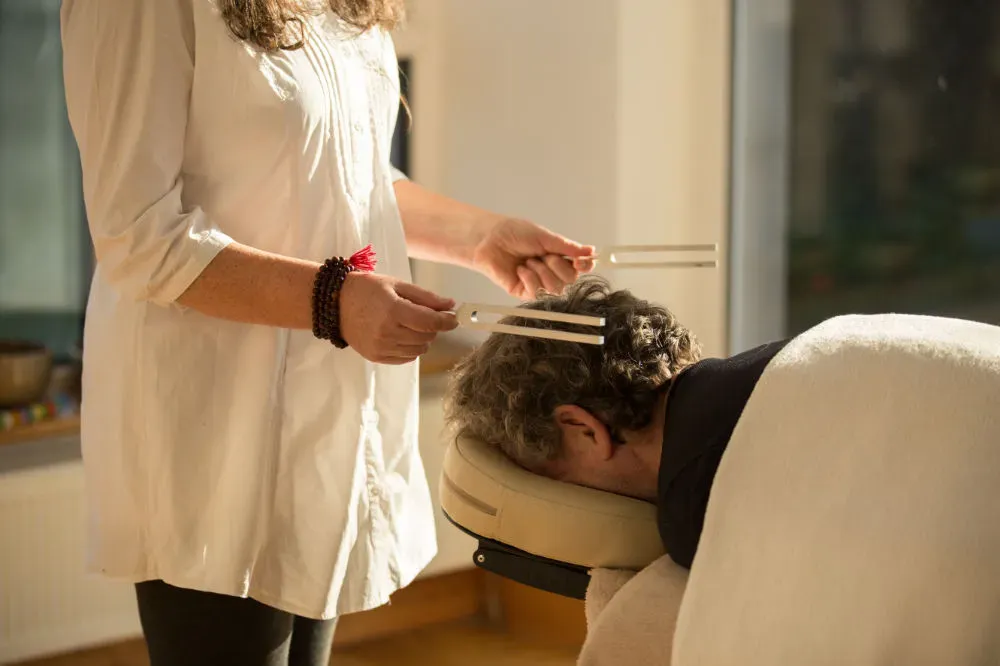
A tuning fork can offer precision of frequency. A singing bowl can offer extraordinary purity of tone. The human voice offers another kind of precision: the truth and immediacy of this person, this moment, this relationship.
In this training, we explore that potential with both wonder and rigour.
You will learn not only how to work with therapeutic voice and sound, but also explore why sound affects us—through the study of vibration and resonance, auditory perception, breath, attention, the nervous system, relationship and the embodied experience of sound.
What is Sound Healing with the Voice?
At its heart, this work is not about doing healing to another person.
The practitioner does not arrive with all the answers, nor with the intention of fixing someone who is broken.
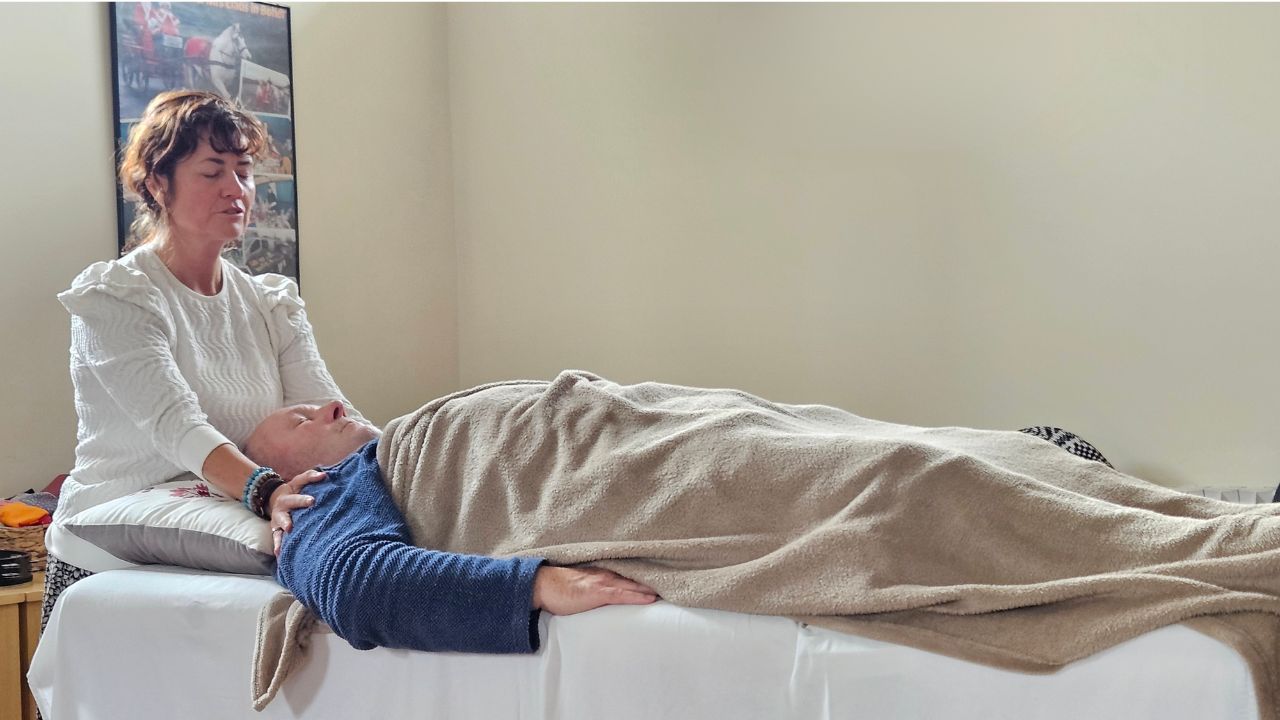
Our role is to create and sustain the best conditions we can: a professional, compassionate and attentive space in which a person feels received and heard.
Through deep listening, skilled use of voice, sound and silence, and careful responsiveness to the person in front of us, we support conditions in which the client's own capacities for regulation, integration and healing may become more available.
Sometimes sound is called for.
Sometimes silence.
Sometimes we offer.
Sometimes the most skilful thing we can do is hold back.
This is why the training is about much more than learning techniques.
It is about becoming a practitioner capable of listening deeply enough to know how—and whether—to use them.
We can study sound carefully and still be astonished by it.
This training begins with listening
Before we can accompany another person, we need to learn how to listen.
And the practitioner listens in two directions.
Outwards, to the client: to breath, voice, words, silence, movement, feedback and subtle changes throughout the session.
Inwards, to themselves: noticing assumptions, conditioning, discomfort, urgency, the desire to help, and the temptation to fix.
This double listening is at the heart of the training.
You will develop your own grounding and voice practice alongside your professional skills—not because a practitioner must be perfectly healed or permanently calm, but because self-awareness helps us remain present without unconsciously placing our own needs or stories upon the client.
The techniques matter.
But the deeper practice is becoming sufficiently grounded, self-aware and responsive that the quality of your presence becomes part of the therapeutic relationship.
A professional training in both knowledge and presence
This training holds two commitments together:
You will learn what to do.
You will learn practical, structured methods for offering one-to-one sound healing sessions. You will study the principles that underpin the work, practise with real people, complete case studies and develop the confidence to explain your work clearly and responsibly.
You will learn how to be while doing it.
You will develop the capacity to listen, discern and respond. To work without a fixing attitude. To recognise your own responses. To meet the client as a whole person. To know when to use sound and when silence may be more appropriate.
By the end of the training, my hope is not simply that you have acquired a collection of sound healing techniques.
It is that you are becoming a grounded, reflective and skilled practitioner: someone who can meet another human being with knowledge, humility, compassion and care.
Join the 2026 TrainingWhat makes this training different?
There are many ways to work with therapeutic sound. This training has a particular focus
The human voice is the primary instrument
You will explore humming, toning, vocal resonance, harmonics, chant, mantra, musical intervals and other approaches to therapeutic voice.
This is not performance training, and you do not need to consider yourself a singer.
We begin with the voice that is already here.
Understanding matters
You will explore the principles and theories that help us understand our responses to sound, while learning to distinguish between established knowledge, developing research, traditional frameworks and lived experience.
My aim is not to use science to prove mystery—or mystery to replace science—but to help you become thoughtful and responsible in how you understand and explain your work.
The work is embodied
We do not learn sound only by reading about it.
You will sound.
Listen.
Receive treatments.
Give treatments.
Practise.
Reflect.
Study.
Return.
Personal practice and professional formation belong together
You will work with your own voice and your own relationship with sound throughout the year.
Not because the training is therapy, and not because personal experience alone qualifies anyone to work with others.
But because the instrument you are working with is inseparable from you.
Your own practice is part of learning to work responsibly.
By the end of the training
You will be able to:
- offer structured one-to-one sound healing treatments with greater confidence and professional awareness;
- understand key principles of sound and therapeutic voice, and communicate them clearly and responsibly;
- use practical voice- and sound-based methods within a coherent treatment structure;
- work with resonance, vibration, rhythm, harmonics, musical intervals, mantra, silence and selected instruments;
- bring greater nervous-system awareness and trauma-aware sensitivity to your practice;
- listen more skilfully to the client while remaining aware of your own responses;
- develop discernment about when to use sound, when to adapt and when to hold back;
- establish clear professional boundaries and practices around client care;
- develop a more grounded, confident and compassionate relationship with your own voice.
The Learning Journey
MODULE ONE
Beginning with the Voice
Your own voice is the starting point.
We begin by exploring breath, listening, tone, resonance and the experience of sounding from within the body. You will begin developing your personal practice while experiencing the foundations of voice-led sound healing.
We explore: voice, breath, pure tone, harmonics, chant, vowel sounds, meditation and the experience of a sound healing treatment.
MODULE TWO
The Theory and Practice of Sound Healing
Here we begin asking the essential questions:
Why does sound affect us?
What is resonance?
What is entrainment?
What roles do attention, intention, relationship and silence play?
How do we translate understanding into safe, responsive practice with another person?
You will learn a foundational structure for a one-to-one treatment and begin developing your practitioner skills.
MODULE THREE
Music as Medicine
Held over two weekends, this module explores music itself as a therapeutic medium.
You will work experientially with musical intervals, the Indian scale, listening, rhythm and the emotional and embodied experience of music.
This is also where the practitioner journey deepens: learning to notice more, listen more closely and respond with increasing sensitivity.
MODULE FOUR
Sound, the Chakras and Sanskrit
This module explores traditional frameworks of the subtle body alongside practical and experiential work with sound.
You will work with Sanskrit bīja mantras, the relationship between sound and the chakra system, and the elemental associations within the tradition.
Precision matters here—not as performance or perfection, but as a way of entering more deeply into the resonance and embodied experience of the sound.
This weekend also includes supervised practical assessment.
MODULE FIVE
Integration, Advanced Practice and Graduation
The final module is a time for integration.
We review and deepen the principal methods studied throughout the year, explore further applications of therapeutic sound, and reflect on the practitioner you are becoming.
Graduation marks the completion of the taught programme, while the work of practice, reflection and professional development continues.
Module DatesThe year is a practice, not just a course
The learning does not happen only during the six training weekends.
Between modules, you will practise, complete treatments, reflect on your experiences and gradually integrate what you are learning.
The requirement to complete 36 case studies is intentional. Confidence does not come from hearing a technique explained once. It develops through practice: meeting different people, noticing what happens, making mistakes, reflecting, asking better questions and returning to the work.
The written reflections and final essay support another dimension of the training: learning to think carefully about your practice, articulate what you are doing and remain curious about what you do not yet know.
The shape of the year
5
sound healing modules
6
in-person weekends
36
case-study treatments
reflective written work
supervised practical assessment
externally assessed essay
Who is this training for?
This training may be for you if you:
- are already working as a therapist, yoga teacher, bodyworker, voice practitioner, musician or complementary health practitioner and want to integrate voice and sound into your work;
- have experienced the impact of sound personally and feel called to study it with greater depth and rigour;
- want to develop the skills required to offer one-to-one sound healing treatments;
- are interested in the meeting point of voice, embodiment, nervous-system awareness, relationship, contemplative practice and therapeutic sound;
- want a training that values practical competence and personal practice equally;
- or feel drawn to the voice but carry fear, judgement or uncertainty about your own ability to sing.
You do not need singing or musical experience. You do need a willingness to participate, sound, listen, practise between weekends and engage seriously with both the experiential and academic requirements of the course.
A soft and sturdy learning environment
My hope is to create a learning environment that is both soft and sturdy.
Soft enough that you can arrive as you are: curious, uncertain, confident, tired, inspired, challenged.
Sturdy enough to support honest learning, clear boundaries, professional responsibility and the moments of discomfort that can accompany genuine growth.
You do not have to arrive with a perfect voice, a perfectly regulated nervous system or a clear vision of who you will become.
But you will be invited to participate fully.
To listen.
To practise.
To inquire.
To receive feedback.
To notice yourself.
And gradually, to become more capable of offering that same quality of attention to another person.
Why I Teach This Work
I have been exploring voice, sound and healing for more than twenty years.
My own journey began with the voice as expression: a desire to release what had been held, to become freer and to discover what might be possible through sound.
Over time, my understanding has changed.
I have come to trust the gentlest sound. To understand that listening can be as important as expression. To recognise that knowledge does not mean having all the answers for another person. And to see the practitioner's role less as someone who performs healing and more as someone who can create skilful, compassionate conditions for another person's process.
My work now draws together years of practice and teaching in therapeutic voice and sound, alongside my ongoing study of Sanskrit, mantra, meditation, nervous-system awareness and deep listening.
I teach this training not as someone who has reached the end of the path, but as an experienced practitioner and educator committed to the path of practice, inquiry and responsible learning.
My hope is that you leave with both practical confidence and deeper questions: able to work skilfully with sound, grounded in your own practice, and humble enough to keep listening.
Weekend Dates
- 31 Oct/1 Nov 2026 - Module One - Introduction to Sound Healing with the Voice
- 5/6 Dec 2026 - Module Two - The Theory and Practice of Sound Healing
- 6/7 March 2027 - Module Three - part 1 - Music as Medicine
- 10/11 April 2027 - Module Three - part 2 - Music as Medicine
- 26/27 June 2027 - Module Four - Healing through the Chakras
- 2/3 October 2027 - Module Five - Graduation and Advanced Practices
Across the year, each module deepens your understanding and practice of voice-led sound healing, combining experiential learning with professional skills, reflection and supervised practice.
To receive the Sound Healing Practitioner’s Diploma, students must complete the required case studies, written work, practical assessment and final essay. Students must also become Student Members of the College of Sound Healing and hold appropriate insurance and a current First Aid certificate.
Book NowDetailed Curriculum
For those who would like to see the full College of Sound Healing curriculum, the detailed weekend content is outlined below.
Module One – Introduction to Sound Healing with the Voice
Module Two – The Theory and Practice of Sound Healing
Module Three – Music as Medicine
Module Four – Healing through the Chakras
Module Five – Graduation and Advanced Practices
Qualification & Practical Requirements
Assessment & Case Studies
Requirements for Graduation
Additional Costs & Equipment
Attendance & Missed Weekends
Completion Timeline
Cancellation Policy
Voices from the Field
Hear from Students & Practitioners

Perhaps this is your next step
You may already know that sound has a place in your life.
Perhaps you have experienced something through your own voice that you cannot quite explain. Perhaps you already work with people and want to bring voice and sound into your practice with greater understanding, confidence and care. Or perhaps you are standing at the beginning of a new direction and feel drawn to explore where it might lead.
You do not need to arrive knowing exactly what kind of practitioner you will become.
You do need curiosity, commitment and a willingness to practise.
Over the course of this year, you will learn methods and techniques. You will study why sound affects us. You will give and receive treatments, complete case studies, reflect, question and develop your own relationship with voice and listening.
And gradually, you will become more able to offer that quality of attention to another.
The techniques are the vehicle.
The practitioner you are becoming is the deeper practice.
If this way of working speaks to you, I would be glad to welcome you into the next training year.
Sound Healing with the Voice · Professional Diploma
Begins 31 October 2026
Six weekends · Limerick area
Payment Options
Please ensure you have reviewed all the dates and the cancellation policy before committing to this course.
Current fee: €1,875
Full payment in advance - €1725
6 monthly payments of - €312.50
Booking Form
Download Booking FormStill wondering if this training is right for you?
A year-long training is a real commitment of time, energy and resources.
If you feel drawn to the work but have questions about the course, your experience, or whether this is the right time for you, you are welcome to get in touch.
I will answer as clearly as I can.
